A 40 room boutique hotel in Melbourne ran at 82% occupancy last month. The owner was pleased. The monthly board pack showed a strong number, the year-on-year comparison was positive, and revenue was up 4%. By every visible measure, the hotel was doing well.
Then I asked a different question. Of the rooms that were sold, how many were sold at full nightly rate? How many were sold for the full booking window, three nights instead of one? How many of those guests booked a room and then never used the spa, the restaurant, or the late checkout that they paid extra for?
Nobody had the answers on hand. The occupancy number told you the rooms were full. It didn’t tell you whether the hotel was actually being used.
That’s the gap between utilisation vs occupancy. Occupancy tells you how many of your rooms were sold. Utilisation tells you how much of your capacity (rooms, hours, services, staff) was actually used to generate revenue. The two numbers are different. In most hotels, the difference is where the money is hiding.
This isn’t a hotel only problem. The same distinction applies to restaurants, salons, fitness studios, co-working spaces, and any service business where capacity is sold in time slots or units. But hotels are where the gap is widest and the cost is highest.
Why Occupancy Alone Is Misleading, And Where Utilisation Vs Occupancy Splits Apart
Occupancy is a simple ratio. Rooms sold divided by rooms available. If you have 40 rooms and you sell 32 of them, you’re at 80% occupancy. The number is easy to calculate, easy to compare year-on-year, and easy to report up to a board.
That’s exactly why it dominates hospitality dashboards. It’s a textbook example of the KPI trap, a metric that’s easy to track gets tracked, regardless of whether it tells the operator what to do next.
Here’s the problem. A hotel can run at 80% occupancy and still be leaving 30–40% of its potential revenue on the table.
Three reasons.
A sold room is not the same as a fully used room. A guest who books a room for one night at a discounted rate uses the same room a guest who books three nights at full rate uses. Both count as one room sold. Occupancy treats them identically. Revenue doesn’t.
A sold room is not the same as a sold property. A guest who books only the room and ignores the spa, the restaurant, the bar, and the late checkout uses far less of the hotel’s capacity than a guest who uses everything. The room is occupied either way. The hotel is utilised only in one of those cases.
Occupancy doesn’t tell you when the rooms were sold. A 32-room-sold month where 28 of those sales happened in the last week is a very different operational reality from a month where the sales were spread evenly. The total looks the same. The cash flow, the staffing pressure, and the booking team’s workload are completely different.
Three real differences. One headline number. That’s why occupancy alone is the wrong metric to run a hotel on.
Weather is one of the most under tracked demand drivers in hospitality, and not every property even needs to integrate it, the five sign diagnostic for hotel forecasting weather data walks through which properties genuinely would benefit and which should look elsewhere first.

What Utilisation Vs Occupancy Actually Measures Differently
The capacity utilisation rate is a totally different ratio. Capacity used divided by capacity available, measured in a way that accounts for revenue, time, and ancillary services.
For a hotel, utilisation typically looks at:
The percentage of rooms sold at full nightly rate (versus discounted). The average length of stay against the maximum bookable window. The percentage of ancillary services attached to each booking, restaurant, spa, parking, late checkout, breakfast. The revenue per available room (RevPAR), which is the closest single number proxy to utilisation that most hotels already calculate.
When you put these together, you get a picture of how much of the hotel’s actual capacity is generating revenue. That’s the operational question that matters. Occupancy answers the wrong question, are the rooms full? Utilisation answers the right question, is the hotel earning what it could?
A hotel running at 82% occupancy and 55% utilisation has a utilisation vs occupancy problem hidden in plain sight. A hotel running at 65% occupancy and 78% utilisation is healthier, even though the headline number looks worse.
The Four Metrics Every Booking Business Should Track Instead
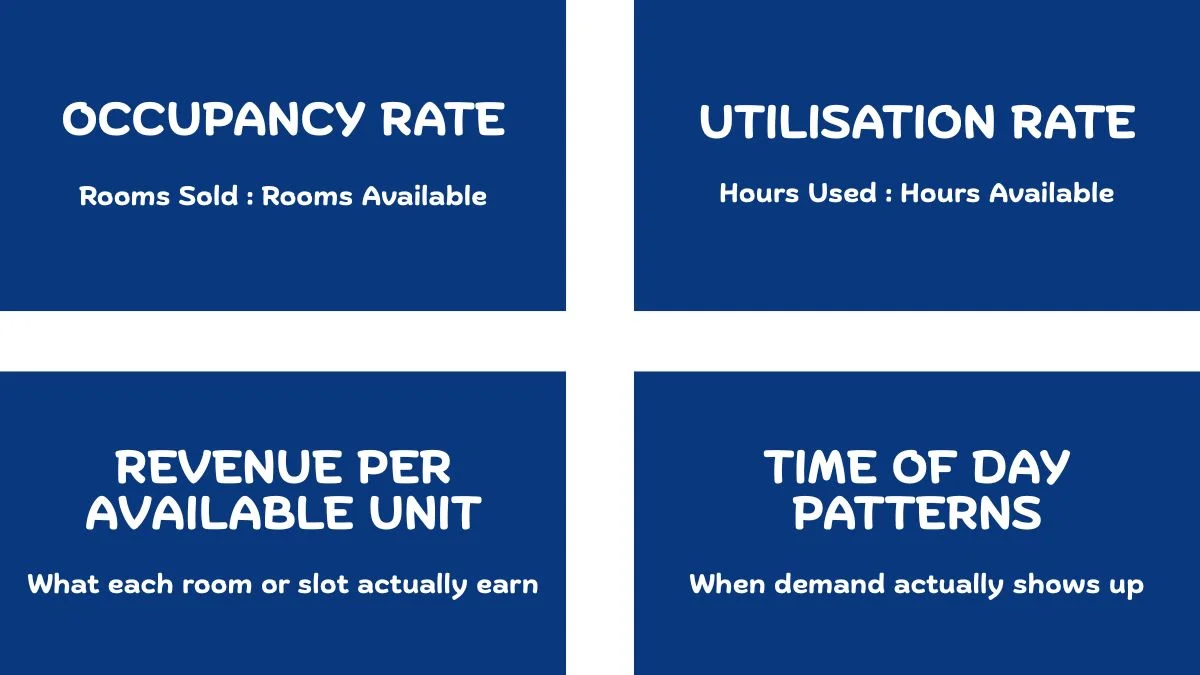
Replacing occupancy with utilisation isn’t really the goal. The goal is to track both, alongside two other metrics, so the picture is complete.
Occupancy rate. Keep it. It’s still a useful top line indicator. Just stop treating it as the answer.
Utilisation rate. Add this as the partner metric. For hotels, this is typically RevPAR or RevPAR plus an ancillary attach rate. For restaurants, it’s covers per available seat-hour. For salons, it’s chair-hours used out of chair-hours available.
Revenue per available unit. This is the dollar version of utilisation. It strips out the fact that a room sold at $150 isn’t the same as a room sold at $300, and gives you a single number that reflects revenue density. For a hotel, this is RevPAR. For a service business, it’s revenue per service slot.
Time of day pattern. Booking driven businesses don’t have flat demand. They have spikes. A hotel that’s fully booked on Friday and Saturday and 30% occupied Monday through Thursday has a very different operational shape than one that’s evenly booked. Same monthly occupancy, completely different operational reality.
If a custom dashboard isn’t quite what you’re after, maybe you need data cleaned, an ad hoc analysis run, or ongoing reporting support, those are services I offer too.
These four metrics together (occupancy, utilisation, revenue per unit, and time of day pattern) give a hotel operator the kind of operational visibility hospitality operators actually need to make decisions about pricing, staffing, promotions, and channel mix. Any one of them alone is misleading.
Why Hotel Chains And Multi Property Operators Miss This
Chains and multi property operators have a specific version of the utilisation vs occupancy problem that’s worth flagging.
When you’re managing 20 hotels, the temptation is to roll occupancy up to a single network number. “Group occupancy is 78%.” That number is almost useless. It hides the fact that three of your properties are running at 92% and two are running at 51%. It hides the fact that one property is utilising 80% of capacity while another sells the same occupancy through deep discounting that drags utilisation to 45%.
Averages hide the variance you actually need to see. The same pattern that breaks multi location retail breaks multi property hospitality. A roll up view that gives you a single number for the network is comforting and operationally useless.
The fix is the same. Track occupancy and utilisation at the property level first, and only roll up when the question is genuinely a network level question, how the group is performing financially, for example. For operational decisions which property needs help, where to focus pricing changes, which manager needs support, only the property level utilisation vs occupancy breakdown matters.
What This Looks Like For Restaurants, Salons And Service Businesses
The utilisation vs occupancy distinction doesn’t only apply to hotels, any business that sells capacity in time slots has the same utilisation vs occupancy gap.
For a restaurant, occupancy is the percentage of tables seated. Utilisation is covers per seat-hour, average check, and the time-of-day spread. A restaurant that’s full from 8pm to 10pm but empty from 5pm to 7pm has the same nightly “occupancy” as one that’s evenly busy across the four hour window. The kitchen pressure, the staff scheduling, and the revenue density are completely different.
For a salon or service business, occupancy is the percentage of chair-hours or appointment slots booked. Utilisation is whether those bookings were full service or quick services, whether they ran on time, and whether the customer added any extras. A 90% booked salon where every appointment is a $40 wash-and-blow is operating very differently from a 75% booked salon where the average ticket is $180.
For a fitness studio, occupancy is class fill rate. Utilisation includes whether the class generated retention, whether attendees added supplements or merchandise, and whether they came back the following week.
he pattern is always the same: occupancy measures whether the slot was sold, utilisation measures whether the business actually made what it could from the slot, and the gap between them is what utilisation vs occupancy is really tracking.

How To Start Tracking Utilisation Vs Occupancy If You Don’t Already
You don’t need a new system to start measuring utilisation vs occupancy properly. You need three things, in order:
Define what “full utilisation” looks like for your business. For a hotel, that might be: room sold at full rate, three night stay, breakfast attached, one ancillary service used. For a restaurant: table sold, full check, two seatings in the evening. Write down your definition. If you can’t write it down, you can’t measure it.
Pull the data you already have and calculate the gap. Take last month’s data and work out the actual revenue per available unit versus the theoretical maximum. The ratio is your utilisation rate. The first time most hospitality operators do this, the answer is somewhere between 50% and 70%. That gap is your opportunity.
Pick one driver to focus on. Don’t try to fix all of utilisation at once. The biggest lever is usually rate (selling rooms at fewer discounts), length of stay (extending the average booking by half a night), or attach rate (getting one more ancillary service on each booking). Pick one, work it for a quarter, then move to the next, that’s how the utilisation vs occupancy gap actually closes.
This is the kind of work a custom operational dashboard built around the right hospitality metrics is meant to support. The dashboard doesn’t make the decisions, but it shows the operator exactly where utilisation is leaking, which means the decisions get made.
The hotel that runs at 82% occupancy and feels successful might be leaving $200,000 a year on the table compared to a hotel that runs at 75% occupancy and tracks utilisation vs occupancy properly. The headline number is the trap. The utilisation vs occupancy view is the truth.
Weather is one of the biggest unexplained variables in hospitality demand, and most properties never join it cleanly to their booking data, here’s how to integrate weather data into Australian hospitality demand forecasting properly.
Elia Lanzuise builds custom operational dashboards for businesses with hidden demand patterns, multi location retail, transport and logistics, booking based services, e-commerce, and hospitality. The work starts with the decisions you need to make, not the charts.
See how the dashboard service works → or explore other data services if you’re not sure what you need.
Pingback: The Hidden Cost of Poor Operational Visibility in Business
Pingback: The KPI Trap: Why Smart Dashboards Fail