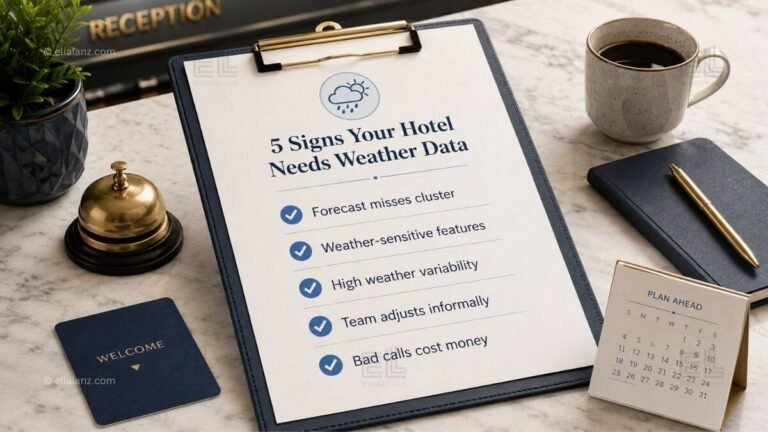
Most articles about hotel forecasting weather data start from the assumption that every hotel needs it. That’s not true. Some properties are extremely sensitive to weather and lose real money every time that data is missing from the forecast. Others run on corporate base demand that barely flinches when the weather changes, and for those properties, building a weather data layer is engineering effort with no payoff.
The honest question isn’t how to integrate weather data into your forecasting. It’s whether you should. And the answer depends on five specific signals that any operator can check in about thirty minutes using data you already have.
If three or more of these signs show up in your hotel, weather data belongs in your forecasting model. If fewer than three show up, your forecasting problem is somewhere else, and weather is a distraction.
Here are the five signs, in plain language.
Sign 1: Your forecast misses are clustered on specific days, not spread evenly
Pull your last six months of daily forecast versus actual. Look at the days where occupancy or revenue missed by more than 10%. If those misses are scattered randomly across the calendar, weather is probably not your problem. Your forecast has a structural issue, such as channel mix, booking pace, or a base demand assumption.
But if the misses cluster on specific days, and especially if they cluster on weekends or holidays, there’s something systematically wrong with your forecast on those days. Weather is one of the top three candidates for what that something is. Hotel forecasting weather data only earns its place when the misses are not random.
The quickest check: list the ten worst forecast miss days from the last six months. If you can remember the weather on more than three of them because of a heatwave, a storm, or an unseasonably cold weekend, weather is in play. If you can’t remember the weather on any of them, it probably wasn’t the driver.
Sign 2: Your property has features that are sensitive to weather
Some hotels are physically built to be weather sensitive. Some aren’t. Walk through the property and answer honestly.
Do you have a pool, outdoor function space, beach access, a rooftop bar, or activities that depend on weather, such as ski hire, surf hire, or trail access? If yes, weather moves your demand. Not slightly. Substantially. Hotel forecasting weather data is the right next step for any property in this category.
Do you have a strong outdoor dining component to your F&B? Restaurant covers on outdoor terraces are one of the hospitality revenue streams most sensitive to weather. A 30°C summer Saturday with clear skies versus the same Saturday with rain can produce a 40% to 70% gap in covers in many properties. If outdoor F&B is more than 20% of your revenue, weather data isn’t optional.
If your property is a corporate city hotel with no outdoor features, no pool used by guests, and an F&B operation that runs the same regardless of weather, your demand probably is not sensitive enough to weather to justify the integration. Spend the engineering time on channel mix or booking lead time instead.

Sign 3: Your location experiences high weather variability
This one is regional. Some Australian locations have stable, predictable seasonal weather. Others swing dramatically.
Some Australian regions swing dramatically: Tropical North Queensland in cyclone season, the Hunter Valley and Yarra Valley, coastal NSW between Sydney and Byron, the Snowy Mountains in shoulder season, and Alice Springs in summer.
A Brisbane CBD hotel in July doesn’t swing dramatically. A Perth city hotel in February doesn’t swing dramatically. A Melbourne CBD hotel in any month swings somewhat but not extremely.
The practical test: pull the last three years of daily weather from the Bureau of Meteorology for your closest station. If the standard deviation of daily maximum temperature in your peak booking months is more than 4°C, you’re in a high variability region and hotel forecasting weather data is worth the work. If it is under 3°C, your weather is usually too stable to move bookings meaningfully. Guests are not surprised by it, so they do not change behaviour.
Sign 4: You’re already adjusting for weather informally, just badly
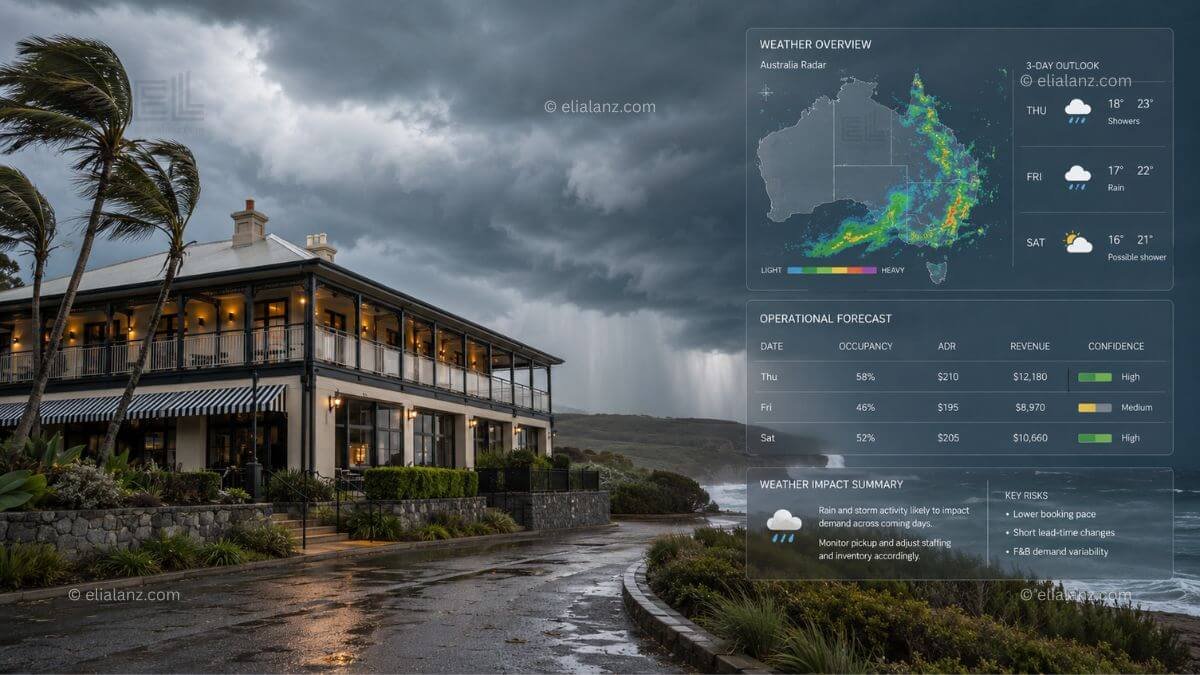
This is the most underrated sign. Many hotel managers already make decisions based on weather, just without data. The duty manager looks at the BoM app, sees rain forecast for Saturday, and quietly cuts a casual shift. The F&B manager looks at the heatwave warning and orders extra stock for the pool bar. The revenue manager sees a storm forecast and holds rates steady instead of pushing them up.
If your team is already doing this, congratulations, you already believe in hotel forecasting weather data. You’re just doing it from memory and gut instead of from a dashboard. The integration work isn’t asking you to adopt a new behaviour; it’s asking you to make the behaviour you already have more accurate.
The diagnostic question: ask your duty manager, revenue manager, and F&B manager separately how often they make a decision based on weather in a typical week. If the combined answer is more than five times, the formal integration can pay for itself through better consistency alone. Different managers will no longer be making different weather calls based on different gut reads.
Sign 5: You can name the dollar cost of getting a weather call wrong
This is the commercial filter. If you can’t quantify what a missed weather call actually costs you, the case for integration is weak, not because the cost isn’t real, but because you won’t be able to measure whether the integration worked.
Examples of operators who can quantify it:
- “When we understaff because we expected a busy Saturday and the weather killed it, we send three casuals home and they still get a half shift minimum. That’s about $480 wasted per bad call.”
- “When we overstaff because the storm forecast cancelled and the day actually was busy, the restaurant turns away walk-in customers We can see about $2,200 in lost covers on a missed Saturday.”
- “When we hold our rates flat because of a storm forecast that doesn’t eventuate, we leave about $4,800 on the table versus our normal pricing on days with favourable weather.”
Examples of operators who can’t yet quantify it:
- “Weather probably costs us something, but we don’t really track it.”
Hotel forecasting weather data is most valuable when you can attach a number to bad weather calls. If you can’t, do that work first, track three months of weather affected days and what they cost you, then revisit the integration question with real numbers in hand.
The Citi Bike project I worked on showed exactly this pattern: joining a full year of NOAA weather observations to trip data revealed that cold weekends were costing the system tens of thousands of trips, a number an operator could actually plan around. The same logic applies to hospitality. Hotel forecasting weather data without a dollar figure attached is an analytical exercise. With a dollar figure, it becomes an operational decision.
Scoring your hotel forecasting weather data readiness: what to do with the five signs
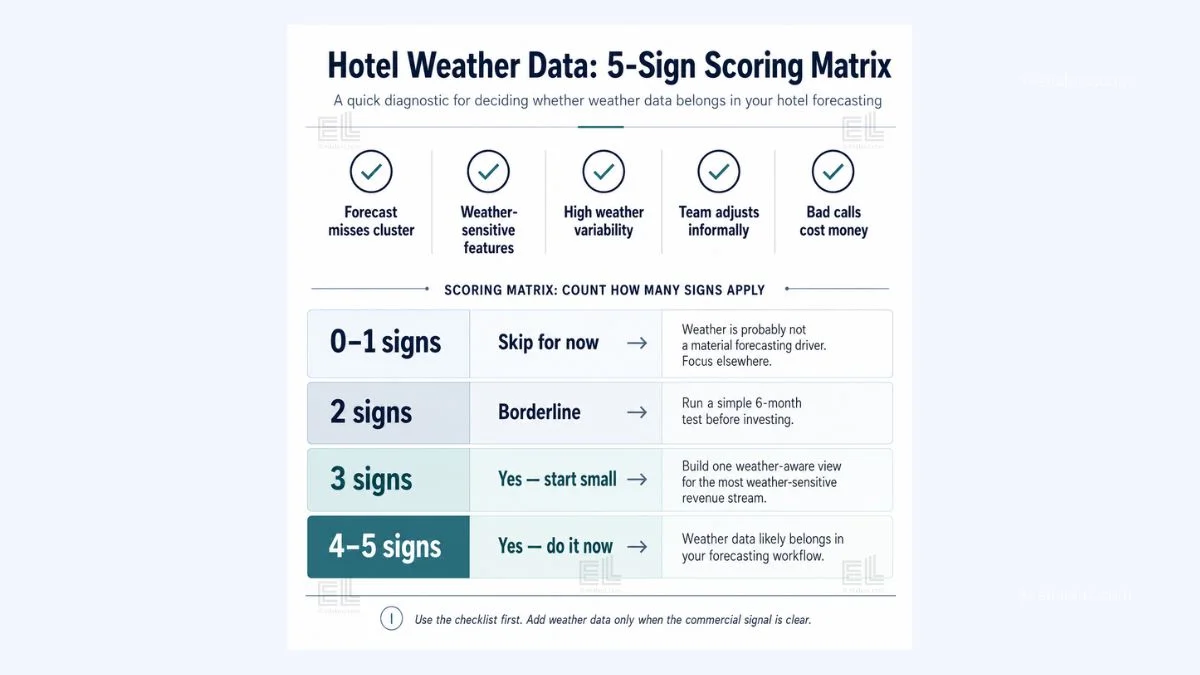
Count how many signs show up in your property:
4 or 5 signs: Hotel forecasting weather data is a clear yes. Your property is weather elastic, in a variable region, and already losing measurable revenue to bad weather calls. Integrate now, the simplest possible version, BoM data joined to your booking and demand records, one operational view a manager checks daily. The article on how to integrate weather data into Australian hospitality demand forecasting walks through the structure.
3 signs: Probably yes, but start small. Build a single operational view that includes weather for one revenue stream, the most weather sensitive one, before scaling to the whole property. F&B covers are usually the right starting point because the signal is strongest and the response is fastest.
2 signs: Borderline. Run an informal test for six months first. Track the worst forecast miss days, log the weather on those days, and see whether a pattern emerges. If it does, revisit. If it doesn’t, your forecast problem is elsewhere.
0 or 1 signs: Skip it for now. Your property either isn’t weather elastic enough or doesn’t have enough operational variance for weather data to make a measurable difference. Focus your analytical investment on channel mix, booking lead time, or rate fence optimisation instead.
What weather data integration is not
Worth saying explicitly, because the marketing around hotel forecasting weather data overstates what it does.
It isn’t a revenue management system. It’s a single input that makes your existing forecast more accurate on weather affected days.
It isn’t a machine learning model. The 80% version is a clean join, two deviation columns, and a dashboard panel. Machine learning is occasionally useful for very large multi property operations and almost never useful for independents.
It isn’t a replacement for operator judgement. A weather aware dashboard makes the duty manager’s call more consistent. It doesn’t make the call for them.
And it is not something you build once and forget. The integration needs to be maintained as BoM stations change, as your booking system updates, and as your demand patterns shift seasonally. Plan for about an hour a month of light maintenance once the integration is live.
The honest commercial reality
Properties that genuinely need hotel forecasting weather data and do not have it can lose somewhere between 2% and 7% of annual revenue to bad weather calls. The loss usually comes from understaffing on days that turn out busy, overstaffing on days that turn out quiet, holding rates incorrectly on weather affected dates, and missing F&B opportunities on days with favourable weather that the team did not anticipate.
For a regional Victoria property with 60 rooms and $4.5M in annual revenue, that’s somewhere between $90,000 and $315,000 of recoverable revenue. The integration needed to capture most of it can cost less than one strong month of mid-tier OTA commissions.
Properties that don’t need it can spend the same engineering budget on the variables that actually move their demand, and get more value from doing so. There’s no shame in deciding weather isn’t your problem.
The point of the five signs is to tell you which group you’re in, before you spend anything.
If your hotel scored three or more signs and you would like the weather demand integration done properly, I offer a fixed scope sprint from $390, delivered in five business days. You get a single operational view that connects weather with your existing booking or demand data, ready to use.
Larger scopes, multi property, multiple data sources, or a full forecasting dashboard, are quoted separately.
I build custom operational dashboards for businesses with hidden demand patterns, multi location retail, transport and logistics, booking based services, e-commerce, and hospitality. The work starts with the decisions you need to make, not the charts.
See how the dashboard service works → or explore other data services if you’re not sure what you need.